Mentions vs Citations in AI Search: What’s the Difference?
Your business can be named in an AI answer without your website being linked, or linked without being named. Here’s what each one means, what the research shows and what to do about it.
6 minutes

Ask an AI tool for the best IT support company in Leeds and you'll usually get a short answer naming a few businesses. Sometimes there are links to websites next to it or underneath. Those links don't always point to the businesses it named.
That gap is what this article is about. When an AI tool names your business in its answer, that's a mention. When it links to your website as a source, that's a citation. They sound like the same thing and they aren't. A business can have one without the other. Each tells you something different about how AI tools see you.
Midwaver, an AI visibility tracker, reports on both, so this guide explains the difference in plain English, what the research says and what you can do about each. If AI search itself is new to you, start with What Is AI Search and Why Should Your Business Care?
Mentions and citations in plain English

A mention is when an AI answer names your business in its text. Something like: "For IT support in Leeds, Pennine IT Support is worth a look for small teams." (Pennine IT Support is an invented example.) The business is part of what the reader sees and remembers.
A citation is when the answer shows a link to a source behind what it's saying. That could be a page on your website, a directory listing, a review site or a news article. Think of it as a page the answer leans on. Tools display these in different ways, so there's no single technical standard.
The simplest way to hold the difference in your head is this. A mention is about who gets named. A citation is about where the information came from. A customer reads the mention first. A citation is what can send them to your website, if they click.
You can have one without the other

Put the two side by side and there are four possible outcomes for your business in any one answer.
Mentioned and cited. The answer names you and links to your website. This is the strongest position.
Mentioned, not cited. The answer names you but the links go elsewhere, such as a directory or a review site. It suggests the AI knows about you mainly from other places.
Cited, not mentioned. The answer links to a page on your website but names other businesses. It suggests your content is useful but nothing in it makes you the obvious choice.
Neither. You're not part of the answer at all.
Those readings are our interpretation. The tools don't explain themselves, so treat each one as a clue rather than a verdict. It's why Midwaver shows how often you're mentioned, where your website is cited and which competitors are named instead. Together they tell you which of the four you're in.
What the research says about the gap

Semrush, which sells AI visibility tools, published a study in June 2026 that looked at exactly this. It examined about 4,000 appearances by companies and websites in answers across ChatGPT, Google AI Overviews, Gemini and Google AI Mode, drawn from 115 prompts in 14 countries. It separated being cited (the website was shown as a source) from being mentioned (the name appeared in the answer text).
The headline result is that around six in ten appearances were a citation with no name in the answer. Semrush calls these "ghost citations". About a quarter were mentions with no citation. Only about one in eight were both.
The tools also behaved differently. Gemini tended to name brands without linking to them. ChatGPT did the opposite.
Treat this as a useful picture rather than a measurement of the whole market. The sample is modest. It comes from one company's tool and Semrush has a commercial interest in the subject. But it supports a point that's easy to miss. Being linked and being named are separate things. A lot of the time they don't arrive together.
How ChatGPT, Perplexity and Google show their sources

Each tool has its own way of showing sources, which is one reason the same business can look different in each.
Perplexity says every answer includes numbered citations linking to the original sources.
ChatGPT search shows inline citations in responses that use search, plus a Sources button that lists them. ChatGPT decides for itself when a question needs a web search, which suggests some answers carry no citations at all.
Google AI Overviews and AI Mode show links to supporting web pages. To appear as one, Google says a page must be indexed and eligible to be shown in Google Search with a snippet. In May 2026 Google also said it was putting more links right next to the text they support.
These features change often, so how a tool shows its sources this month may not be how it does next quarter. Midwaver asks ChatGPT, Perplexity and Google AI Overviews, so you can see how you show up in each rather than assuming one tool tells the whole story.
Which one matters more?
Be wary of anyone who gives you a confident answer. Nobody has reliable figures for what a mention or a citation is worth in sales. The tools keep changing.
Our view, which is an opinion, is that you want both and the mention comes first. The mention is what the customer reads. If you're not named, you're not on the shortlist, however many of your pages are cited. A citation matters because it's the route to your website and a sign that your content is doing a job. It also gives you something to look at, since a cited page is evidence of what the tool found useful.
If the wider question of how all this differs from traditional search is on your mind, GEO vs SEO: What's the Difference? covers it.
What to do about each

The work is mostly the same unglamorous work as always. Which part you lean on depends on where you find yourself.
If you're mentioned but not cited, the AI knows your name but isn't leaning on your website. Make your site easy to rely on. Say plainly what you do, who for and where. Write pages that answer the questions your customers ask, from real experience. Check that the right crawlers can read your site, since security plugins and hosting settings can block them without the owner ever knowing. Adding an llms.txt file, a plain text guide to your site written for AI tools, is cheap and we recommend it. Google says its search systems don't use special AI text files, but that's a statement about Google, not every AI tool. Midwaver flags anything on your site that stops AI tools reading it and shows which sources they rely on, which is a good clue to where your name is coming from.
If you're cited but not mentioned, your content is being used without your name attached. Make sure your business name, what you do and who you do it for appear clearly on the pages most likely to be used. Add something only you can say, such as your own experience, client examples or data you hold. Google's guidance tells site owners to focus on high-quality, non-commodity content, which means content that offers something you can't find everywhere else. Then earn real references elsewhere, such as reviews, directory listings, local press and industry mentions. Google says seeking inauthentic mentions isn't as helpful as it might seem. It's poor practice regardless.
This is our reading of the evidence rather than a documented recipe. Nobody outside these tools can show exactly what makes one business named over another.
If you're in neither, start with the basics in How to Get Your Business Recommended by ChatGPT.
Why one check doesn't tell you much
Open ChatGPT and ask the questions your customers ask. It's worth doing and it's often an eye-opener. Just don't treat one answer as the truth. SparkToro and Gumshoe.ai ran a study in which volunteers put the same prompts through ChatGPT, Claude and Google's AI. The same list of brands almost never came back twice. The study isn't peer reviewed and Gumshoe.ai sells AI tracking tools, a connection the researchers disclosed. Similar questions did tend to return similar sets of brands, so the signal is there. It just doesn't show up in any single answer.
That applies to mentions and citations alike. A business that's cited this week might be mentioned next week or neither. What means something is the pattern across many realistic questions, checked repeatedly. It also matters how that compares with your competitors. Nobody has time to do that by hand every day.
See where you're mentioned and where you're cited
Come back to the IT support company in Leeds. Somewhere an AI tool is answering a question like that for a business like yours. Is your name in the answer? Is your website one of the sources? You can wonder or you can look.
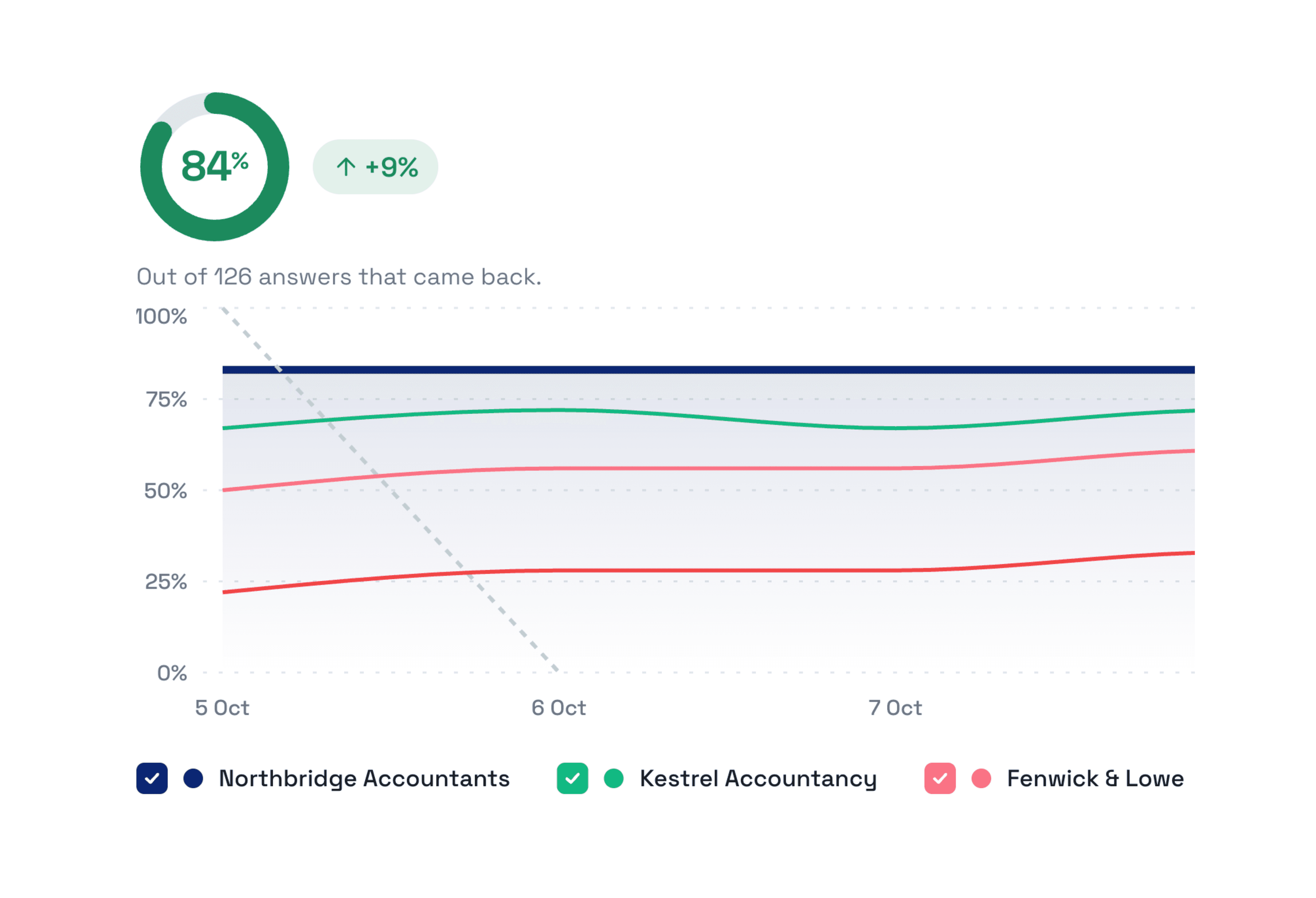
Midwaver is an AI visibility tracker. It asks ChatGPT, Perplexity and Google AI Overviews the questions your customers ask every day and shows you the answers. You can see how often you're mentioned and how that's trending, where your website is cited, which sources the AI tools rely on and which competitors are named instead. A simple dashboard turns the results into clear next steps.
Midwaver can't make an AI tool name you or link to you and no tool can. It shows you where you stand so you can see whether what you change makes a difference.
Start your free 7 day trial. There’s no credit card needed and you can track up to 10 questions in your trial per day. If you’d like more detail first, the features and pricing pages cover the rest.
Don’t let AI search send your customers to a competitor.
See who's being recommended, find where you're missing out and start improving your visibility today.
No credit card required