GEO vs SEO: What’s the Difference?
Is GEO just SEO with a new name? Here’s where the two overlap, where they genuinely differ and what that means for how you spend your marketing budget.
7 minutes

SEO is the work of getting your website found and ranked in search engines. GEO, short for generative engine optimisation, is the work of making sure your business shows up, accurately, when people ask AI tools like ChatGPT, Perplexity or Google’s AI Overviews for answers.
They share the same foundations. They don’t produce the same results and they aren’t measured in the same way. SEO asks “can people find our website?” GEO asks “what does the answer say about our business?”
Imagine you run a business insurance broker in Norwich. Your agency’s monthly report is glowing: you’re on page one of Google for “business insurance Norwich”. Then a new client mentions she asked ChatGPT who to call and you weren’t in the answer. Two competitors were. One of them ranks below you on Google.
That’s an invented example, but it’s a real pattern, and the research below shows why it can happen. It’s also the gap Midwaver was built to show you.
If you want the wider picture first, our guide to what AI search is and why your business should care covers it. Our guide to getting your business recommended by ChatGPT goes deeper on that one tool.
What SEO is
SEO stands for search engine optimisation. It’s the long-standing practice of making your website easy for search engines to find and understand, and worth showing to people. That means a site that works properly, pages that answer what people are searching for and signs that other people trust you, such as links from other websites.
Success in SEO is fairly easy to see. You can check where your pages appear in the results, how many people click and how many of them become enquiries.
What GEO is
GEO is the newer term. It’s commonly used for improving how visible your business and content are inside generative AI tools, the ones that write an answer rather than list links.
Nobody has agreed on a single definition. You’ll also hear AEO, short for answer engine optimisation, which means much the same thing. Different agencies use different words for roughly the same idea, so don’t read too much into which acronym someone prefers.
The term GEO itself comes from a 2024 research paper by researchers at Princeton and other institutions. We’ll come back to what it found.
Where they overlap (which is most of it)
Google’s position is blunt. In its official guidance, Google says that optimising for generative AI search is optimising for the search experience, and so it’s still SEO. Danny Sullivan, a director in Google Search, put it more briefly: good SEO is good GEO.
In practice, that means the usual things. A page has to be indexed and eligible to appear in Google Search before it can be shown in AI Overviews or AI Mode. Beyond that, Google points to helpful content from real experience, a clear site structure, a good experience for visitors and accurate business information in tools like Google Business Profile. It also says you can skip some popular tricks, such as chasing artificial mentions. Google also says its search systems don’t use special AI text files such as llms.txt. That’s a statement about Google, not about every AI tool, and a file like that is cheap to add.
That guidance covers Google’s own AI features, not ChatGPT or Perplexity. But the same basics apply across the board. If an AI tool can’t read your website, or your website says nothing clear or useful, no amount of clever optimisation will rescue you.
So if you hear that GEO means throwing away SEO and starting again, be sceptical. The foundations are shared.
Where they genuinely differ
Overlap isn’t the same as identical. Here’s where the two pull apart.
You’re competing for a different thing

In traditional search, you compete for a place in a list. In AI search, you compete for a place in an answer, and an answer has room for a handful of names, not ten. A user scanning ten links can decide for themselves. A user reading one confident paragraph often won’t look further.
That’s the Norwich problem. Page one is a place in the list. Being named in the answer is something else.
Different things do the choosing
A search engine ranks pages. An AI tool does something more involved. Google says its AI features may use “query fan-out”, which means running several related searches around a question and combining what they find. For our Norwich broker, an AI tool might quietly search for insurers who specialise in small businesses, how much cover a company needs and what to look for in a broker.
Different AI tools also find information in different ways. ChatGPT search has its own crawler, which is a bot that reads web pages. Perplexity has its own. Google’s AI features draw on Google’s systems. So you can be easy to find in one and hard to find in another.
What other people say about you seems to matter too. The SEO software company Ahrefs found that how often a brand is mentioned across the web lined up more closely with appearing in Google’s AI Overviews than links to its own site did. That’s a correlation, not proof, and it covers Google only. But it fits the pattern: being talked about by others is part of being recommended. It’s one reason Midwaver shows you which sources the AI tools rely on when they answer questions about your business. That’s a good clue to where mentions matter.
It’s less predictable

Google’s results can move around, but at any moment there’s one list you can look at. AI answers vary. SparkToro and Gumshoe.ai asked hundreds of volunteers to run the same prompts through ChatGPT, Claude and Google’s AI. The same list of brands came back fewer than once in 100 runs. That study isn’t peer reviewed, and Gumshoe.ai sells AI tracking tools, a connection the researchers disclosed. Even so, it matches what anyone sees when they try it.
The same research found that differently worded questions with the same meaning tended to return similar sets of brands. So the signal exists. It just doesn’t show up in any one answer.
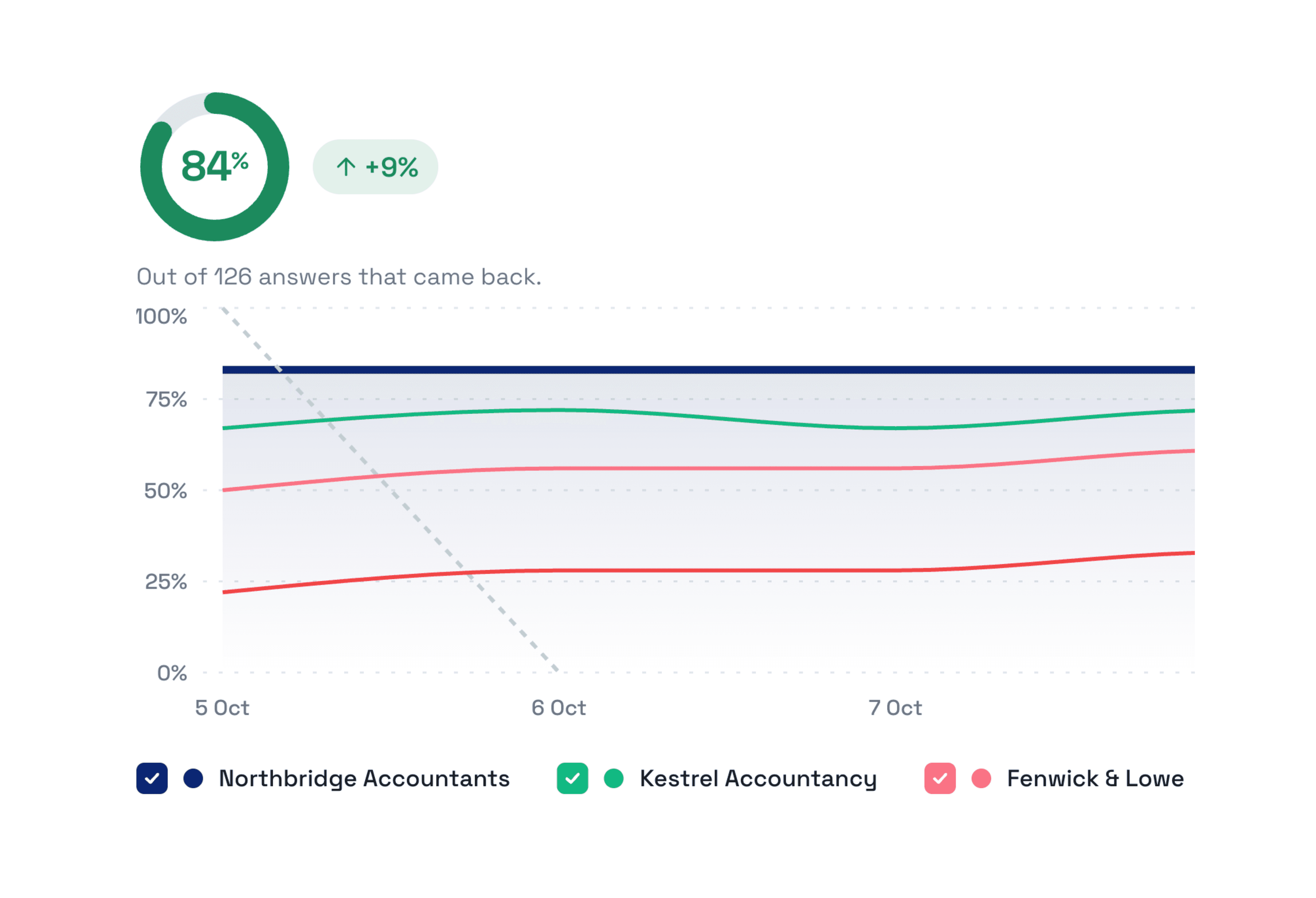
That’s why checking by hand can mislead you. One answer is a snapshot. What matters is how often you appear across many questions, over weeks. It’s why Midwaver asks the questions your customers ask every day and tracks the pattern, instead of relying on a single result.
It’s harder to see

With SEO you have robust tools. Google’s Search Console shows how your pages perform. Google has since added a Generative AI report there, which shows how often your pages appear in AI Overviews and AI Mode. It’s useful, but it only covers Google, and it shows impressions rather than clicks or what the answer actually said. It can’t tell you whether ChatGPT names you, or who it names instead.
This is the practical heart of the difference. SEO has a scoreboard. GEO, for most businesses, doesn’t yet. That gap is the reason tools like Midwaver exist. They don’t replace Search Console. They cover the part it can’t see.
Does ranking well on Google get you into AI answers?

Often, to a degree. But the research disagrees about how much, and the numbers keep changing.
In mid-2025, Ahrefs found that about 76% of pages cited in Google’s AI Overviews also ranked in Google’s top 10 for the same search. A later, larger update put it at 38%, partly because the AI now draws on related searches as well as the one the user typed. For ChatGPT, Gemini, Copilot and Perplexity, a separate Ahrefs study found only around 12%.
Different studies use different methods, so the figures aren’t directly comparable. The lesson isn’t a single number. It’s that rankings and AI citations overlap, but only partly, and the link keeps moving. A good ranking is a sensible foundation. It isn’t proof you’re being recommended.
What the research says about GEO tactics
The Princeton paper is the best-known piece of GEO research, so it’s worth knowing what it did and didn’t show.
The researchers tested several ways of rewriting website content to see which made a source more visible in AI-generated answers. Three stood out: adding relevant statistics, adding quotations from credible sources and citing sources. Making text clearer and easier to read helped too. Stuffing in extra keywords, a classic old SEO move, gave little or no benefit.
There are caveats. It was a research experiment using an older AI model, not a live test on ChatGPT. It started from pages that had already been found, so it tells you little about how to be found in the first place. And the gains were measured on specific tests, not promised results.
There’s still a sensible takeaway, and it’s less technical than it sounds. Say things plainly. Back up claims with evidence. Name your sources. That’s good writing, and it’s good for readers whether or not a machine is involved.
So do you need both?

You need the foundations, and you need to know what AI tools are saying about you. The order matters.
Get the SEO foundations right first. A website that’s easy for bots to read, clear about what you do and where, with useful pages and accurate listings, serves both. If this is shaky, fix it before spending anything on “GEO”.
Then add what GEO emphasises. Make your key facts clear and specific, and back them with evidence where you can. Keep your business details consistent across your website and listings. Earn genuine mentions: reviews from real clients, directories your industry uses, coverage in the press. And check that the AI tools’ crawlers aren’t blocked, because security settings often block them without anyone realising.
Then measure both. Use Search Console for how you perform in Google, including its AI features. And find a way to see what the other AI tools actually say, because nothing in your usual reports will show you. That second part is what Midwaver does.
Three questions to ask anyone selling you GEO

Because the term is new, the market is noisy. Before you pay for a “GEO” service, ask:
What exactly will you do that good SEO wouldn’t? A good answer is specific. A vague one is a warning sign. Google’s own guide says to be careful with third-party “AEO” or “GEO” advice.
How will you measure it? Anyone who promises a precise “ranking position” in AI answers is overselling, given how much those answers vary. Look for measurement across many questions, repeated over time.
What happens if it doesn’t work? Nobody outside the AI companies controls what their tools say. Be wary of guarantees.
Find out where you stand in AI answers
Page one of Google and a place in the answer are two separate questions. Only one of them shows up in your usual reports.
Midwaver is an AI visibility tracker. It shows you how often your business appears when people ask ChatGPT, Perplexity and Google AI Overviews for recommendations. You can see which competitors get named instead, how you’re described and which websites the AI tools rely on. You get a simple dashboard and clear suggestions for what to improve.
Midwaver can’t make an AI tool recommend you and no tool can. What it does is show you what the AI tools really say about your business, so you can decide what to do about it.
Start your free 7 day trial. There’s no credit card needed and you can track up to 10 questions in your trial per day. If you’d like more detail first, the features and pricing pages cover the rest.
Don’t let AI search send your customers to a competitor.
See who's being recommended, find where you're missing out and start improving your visibility today.
No credit card required