What Is AI Search and Why Should Your Business Care?
AI tools are now being asked who to hire, who to buy from and who to trust. Here’s what AI search is, how it differs from Google and what it means for your business.
8 minutes

AI search is search that uses generative AI to work out what someone is really asking, find relevant information and write them an answer. It often happens in conversation and sometimes comes with links to its sources. ChatGPT search, Perplexity, Google's AI Overviews and Google's AI Mode are the best-known examples.
The technology isn't the interesting part for a business owner. What people are asking it is. Increasingly, it's who to hire, who to buy from and who to trust.
Picture a founder in Manchester asking an AI tool to recommend an accountant who can handle tax and payroll for a small company. She gets a short, confident answer naming a few businesses. She rings one of them. Perhaps yours isn't among them.
Here's the uncomfortable part. You wouldn't know. Your Google rankings needn't change and your website traffic might not move. Nothing in your usual reports is likely to flag a missed opportunity. The shortlist was drawn up somewhere you can't see and you weren't on it.
This guide explains what AI search is, how it differs from the Google you know, why that matters commercially and what you can sensibly do about it, including the parts nobody can control. It's also the problem Midwaver, an AI visibility tracker, was built to solve. We'll come back to that at the end.
What AI search actually is

Under the bonnet, an AI search tool usually does three things. It works out what the person wants, even from a long or messy question. It finds relevant information from the live web, a search index, what the AI model learned in training or some mix of those. Then it writes a response that pulls it all together.
How it does that varies by product. Some tools run a web search for most questions and attach numbered sources. Some decide for themselves whether a search is needed at all. Some show links prominently and some barely show them. The whole field is moving quickly, so how a tool behaves this month may not be how it behaves next quarter. "AI search" is a family of experiences rather than one thing, which is worth remembering whenever someone tells you exactly how it works.
These are the ones you'll hear about most:
Google AI Overviews are AI-written summaries that appear above the usual results on some searches. Google says they show up only when its systems judge they add something, so plenty of searches don't trigger one.
Google AI Mode is a separate, more conversational mode inside Google, designed for questions that need comparing or reasoning through.
ChatGPT search lets ChatGPT look things up on the web when a question would benefit from current information. OpenAI uses its own crawler, OAI-SearchBot, to find pages to surface.
Perplexity is built around answering with sources. It searches, then writes a response with numbered citations.
There are others, including Microsoft Copilot and Gemini, each with its own way of finding and presenting information.
How AI search differs from the Google you know

You'll often hear that Google gives you a list of links while AI gives you an answer. That was roughly true a couple of years ago. It isn't now. Google's results page already carries maps, reviews, shopping panels, videos, knowledge panels and AI summaries. Traditional search hasn't gone anywhere.
The real difference is in what the person is asked to do. A conventional results page hands you material and leaves you to work out the answer. AI search can do some of that work for you. It can cope with a long, conversational question, combine information from several sources, compare options, take follow-up questions and explain why it's suggesting what it suggests. Not every tool does all of that and none does it for every query.
Take someone who types "accountant Manchester" into Google. They'll probably see local results, ads, reviews and a handful of organic listings, perhaps with an AI summary on top. Now imagine the same person asking an AI tool:
"I'm starting a small business in Manchester. Who are some good accountants that work with small companies and can help with tax and payroll?"
They might get a conversational answer that discusses several businesses and says what each is known for. We can't promise that. Different tools will answer differently. But the first search asks the person to evaluate. The second asks the system to shortlist.
If you're on that shortlist, it's a significant moment. If you're not, you may never know you were in the running.
People are using it to choose businesses
This is where it gets commercial. People don't only use AI search to look things up. They use it to decide. Imagine questions like these:
"What's the best accounting software for a small construction company?"
"Who are the best employment solicitors in Leeds?"
"Which insurance companies offer ethical home insurance?"
"What are the best marketing agencies for a small SaaS company in the UK?"
"Which estate agents should I speak to if I'm selling a property in Marbella?"
Every one of those is a buying question. The person asking hasn't picked a business yet. They want a recommendation and they're asking a system to supply one.
That changes what you need to know about your own marketing. "Does my website rank?" is still a fair question. But there's now a second one: when potential customers ask questions like these, is my business part of the answer?
The two don't always have the same answer.
How big is this, really?
Let's be careful, because this topic attracts exaggeration. Nobody has reliable figures for what share of buying decisions now involve AI search. Anyone quoting a confident percentage is guessing. What we do have is evidence that the behaviour is real and growing.
Ofcom's latest research on UK adults' media habits found that the use of AI tools such as ChatGPT, Copilot or Gemini has risen sharply in a year. Most online adults now read AI-generated search summaries at least sometimes.
There's also what people do when those summaries appear. A Pew Research Center study of US adults found they clicked traditional results roughly half as often when an AI summary appeared. Links inside the summary were rarely clicked. That's US data from 2025, so treat it as a snapshot. But it explains why being named in the answer can matter as much as being listed underneath it.
None of this means AI search is replacing Google. It means it's becoming another way people find information, businesses and services. It behaves differently enough to deserve its own attention.
The blind spot in your reporting

Most businesses judge their search performance by rankings, traffic and enquiries. Those numbers matter. They also have a gap.
Your analytics show people who arrived at your website. They can't show you a conversation where an AI tool recommended three of your competitors and someone acted on it. Google's Search Console now includes AI Overviews and AI Mode in its reporting. OpenAI says ChatGPT adds a tracking tag to links it sends, so you can spot visits from it in your analytics. All useful. But they show how your own pages perform. They only cover people who clicked. They can't show you the answers where you weren't named, or who was named instead.
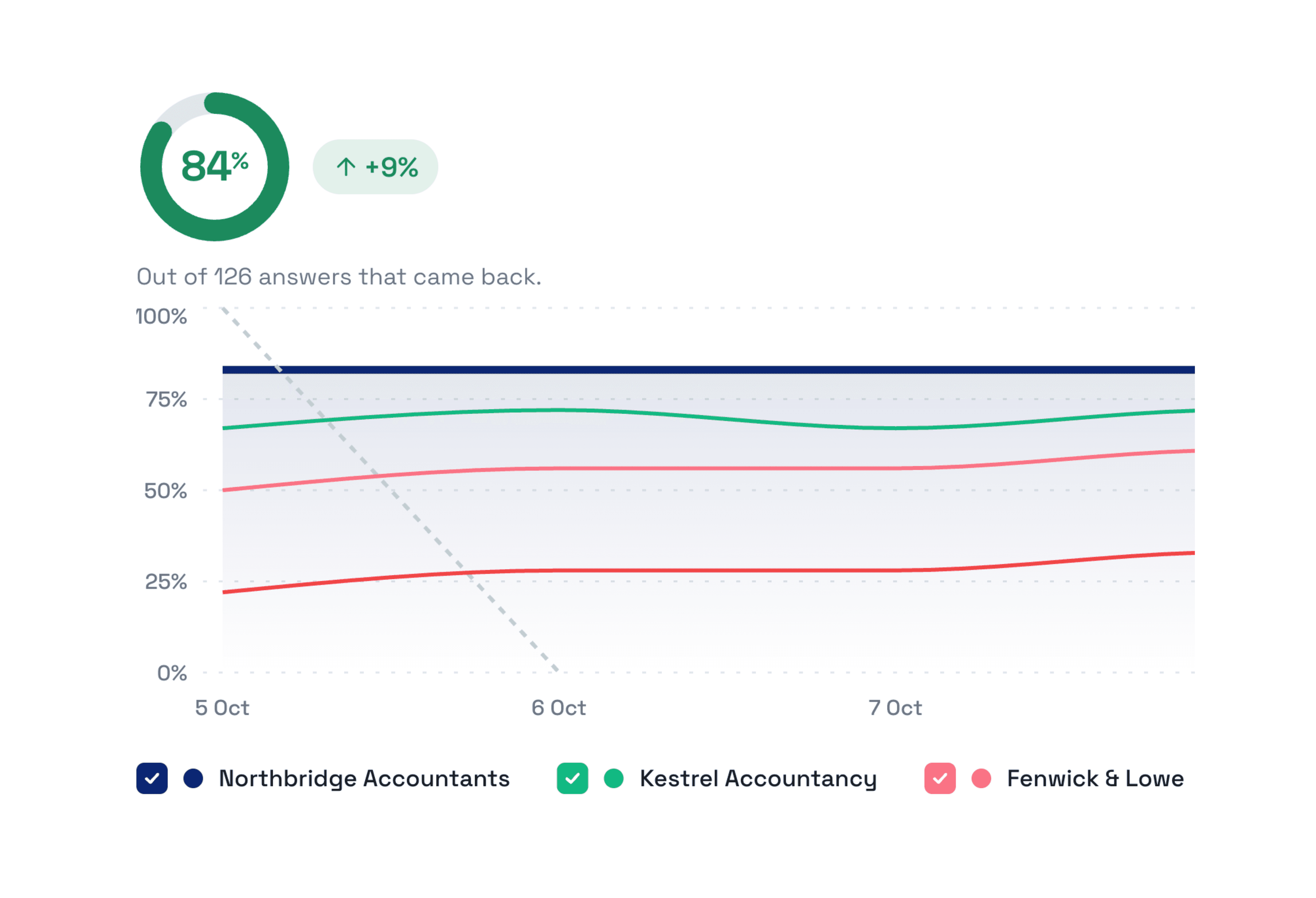
That's what people mean by AI visibility: how visible and how well represented your business is when people ask AI tools the questions your customers ask. It goes beyond whether you appear at all. It includes how often you're named and for which questions, who appears instead of you, how you're described and whether that description is accurate. It also covers whether your website gets credited as a source and how all of that shifts over time. It's the gap Midwaver was built to cover.
A word of caution about "ranking". Google's organic results have positions. AI answers often don't. A response might name four businesses in a paragraph with no meaningful order. The next person asking the same question might get a different four. Treating one answer as your ranking is like judging a restaurant on one dinner. Visibility is better read as a pattern across many questions and many repeats.
Being mentioned and being cited are different

It helps to separate two things. A mention is when an AI answer names your business. A citation is when the answer points to a source behind what it's saying. Different tools show sources in different ways, so think of a citation as "a page the answer leans on" rather than one technical standard.
You can have one without the other. Say an AI tool recommends your business by name but links only to a directory listing. That's a mention without a citation. It suggests the AI knows about you mainly from other places. Or it might cite a helpful guide on your website and then recommend three other businesses. That's a citation without a recommendation. It suggests your content is useful but nothing about it makes you the obvious choice. Neither is a disaster. They're different problems and you'd want to know which one you have.
Why a strong Google ranking doesn't settle it
If good SEO still matters, you might assume that ranking well means you'll turn up in AI answers. Often there's overlap. It isn't a guarantee though. The reasons don't require anyone to know the inner workings of a model.
First, an AI tool may be doing far more than one search. Google says AI Overviews and AI Mode may use "query fan-out", which means generating several related searches around a question and drawing on all of them. For our Manchester founder, that might quietly include searches for accountants who specialise in start-ups, payroll services for small companies and what to look for in an accountant. The pages that shape the answer may not be the ones that rank for your obvious keyword.
Second, different tools find information in different ways. ChatGPT search has its own crawler. Perplexity has its own. Google's AI features draw on Google's search systems. A business can be easy to find in one and hard to find in another.
Third, what's said about you elsewhere counts. Google notes that its AI features can reflect what's being said about products and services across the web, including blogs, videos and forums. Reviews, directories and press coverage can all feed the picture. You can rank well on Google and still be described thinly, or wrongly, because the wider picture of your business is patchy. Midwaver shows you which sources the AI tools rely on when they answer, which is a good clue to where that picture comes from.
SEO, AEO and GEO in plain English
You'll see three acronyms. SEO is search engine optimisation, the long-standing work of making your website easy to find and useful in search. AEO is answer engine optimisation, which generally means presenting information so it answers questions clearly and can be pulled into answer-style results. GEO is generative engine optimisation, the newer term for improving how visible your business is inside generative AI tools.
Be wary of anyone who treats these as separate, settled disciplines. There's no single agreed definition of GEO and the terminology is still being worked out. The term itself comes from a 2024 academic paper by researchers at Princeton and elsewhere. In their experiments, some content changes made sources appear more often in AI responses. That's interesting evidence that the subject is worth taking seriously, but it was a research setting, not a recipe for any particular product.
Google's own view is blunt. In its official guidance, Google says that from its perspective, optimising for generative AI search is optimising for the search experience. So it's still SEO. A page needs to be indexed and eligible to appear in Google Search with a snippet. There are no extra technical requirements. Google says you can skip some popular tricks, such as chopping content into tiny pieces or chasing artificial mentions. It also says its search systems don't use special AI text files such as llms.txt. That's a statement about Google, not about every AI tool. A file like that is cheap to add. The guidance covers Google's own AI features only. Even so, it's a useful corrective to anyone selling a secret formula. As far as anyone can publicly show, there isn't one.
What you can realistically do

The useful actions are mostly unglamorous. Each has a reason behind it.
Start with your own website. An AI tool, like a person, can only describe you accurately if the information is there in plain language. An accountant whose homepage says "financial solutions tailored to you" gives a system very little. "Accountants in Manchester for owner-managed businesses, covering tax, payroll and year-end accounts" gives it something to work with. Say what you do, who for and where.
Then build pages that answer the questions your clients actually ask, from real experience. Google's guidance says content with a genuinely original point of view tends to matter more than a rehash of what's already out there. If you have a view on how to handle a first VAT registration, or a story about a client's tax problem, that's worth far more than a generic list of tips anyone could have written.
Keep your details consistent. Your name, services, address and contact information should match across your website, your Google Business Profile and any directories you're listed in. Google notes that business details in tools like Business Profile can appear in its AI responses. Inconsistency is how mistakes get repeated.
Earn real references. Reviews, directory listings, local press and industry mentions all add to the picture of who you are. Genuine is the operative word. Google specifically cautions against seeking inauthentic mentions. It's bad practice regardless.
Check that the right crawlers can read your site. OpenAI says that if a site opts out of OAI-SearchBot, it won't be shown in ChatGPT search answers, though it may still appear as a plain link. Security plugins, hosting settings and content delivery networks can block crawlers without the owner ever knowing, which is why both Google and OpenAI tell site owners to check. Midwaver also flags anything on your site that stops AI tools reading it.
Which brings us to the one thing none of that can tell you: what the tools are actually saying about you.
What nobody can control
It's worth being plain about this. You can't directly control what ChatGPT, Google or Perplexity says about your business. You can't guarantee you'll be included, described a certain way or recommended first. Models change, search systems change and the same question can produce different answers on different days.
That isn't a reason to ignore it. It's a reason to measure it. You can't control the weather either but you'd still rather read the forecast.
Why checking by hand only gets you so far
The obvious first move is to open ChatGPT, ask the kind of question your clients ask and see what comes back. Do it. It's an eye-opener.
Just don't trust a single result. SparkToro and Gumshoe.ai ran a study in which hundreds of volunteers put the same prompts through ChatGPT, Claude and Google's AI. The same list of brands came back fewer than once in 100 runs. The study has limits. It isn't peer reviewed and Gumshoe.ai sells AI tracking tools, a connection the researchers disclosed.
It also held some reassurance. Even when prompts were worded quite differently, the tools tended to return similar sets of brands for the same underlying need. So the signal is there. It just doesn't show up in any one answer.
The lesson is that a precise "ranking position" in AI search should be treated with suspicion. What means something is how often you appear across many realistic questions, checked repeatedly. It also matters how that compares with your competitors. Nobody has time to do that by hand every day.
Find out what AI says about your business
Come back to the founder in Manchester, asking for an accountant. Somewhere, an AI tool is answering a question like hers for a business like yours. You can wonder what it says. Or you can look.
Midwaver is an AI visibility tracker. It asks ChatGPT, Perplexity and Google AI Overviews the questions your customers ask and shows you what they say. You can see how often your business is named, how you're described, which competitors appear instead and which websites the AI tools rely on. A simple dashboard turns the results into clear next steps.
Midwaver can't make an AI tool recommend you and no tool can. It shows you where you stand so you can see whether what you change makes a difference.
Start your free 7 day trial. There's no credit card needed and you can track up to 10 questions in your trial. Add your website, pick your competitors and see who's being recommended. If you'd like more detail first, the features and pricing pages cover the rest.
AI search won't replace everything you already do. But more of your customers will ask it for recommendations. It's far better to find out what it says before they do.
Don’t let AI search send your customers to a competitor.
See who's being recommended, find where you're missing out and start improving your visibility today.
No credit card required