How to Measure Your AI Search Visibility
AI answers change every time you ask, so one check tells you very little. Here’s a simple way to measure how often AI tools mention and cite your business.
5 minutes

Choose the questions your customers ask, then put them to ChatGPT, Perplexity and Google's AI tools on a regular schedule. Note down whether your business is mentioned, whether your website is cited and which competitors are named instead. AI answers change from one run to the next. So count how often you appear across many checks rather than trusting one result. Your website analytics and Google Search Console can fill in part of the rest.
That's the whole method. The rest of this guide shows how to do it by hand, which numbers are worth tracking and which ones to ignore. We make Midwaver, an AI visibility tracker that does the repeat checking for you. If AI search is new to you, start with What Is AI Search and Why Should Your Business Care?
Why one check isn't enough
Ask an AI tool the same question twice and you can get two different answers. That makes it unlike checking where you rank on Google.
SparkToro and Gumshoe.ai put a number on it in a study. About 600 volunteers ran 12 prompts through ChatGPT, Claude and Google's AI tools, which came to 2,961 runs. The tools rarely gave the same list of brands twice. It happened fewer than once in 100 runs, whatever the question. The same list in the same order was rarer still.
Gumshoe.ai sells AI tracking tools, a connection the researchers disclosed. They also say the work wasn't peer reviewed and covers one window in late 2025. So treat the exact numbers with care. The message is still clear enough.
The authors suggest the sensible measure is a visibility percentage. That means how often a brand shows up across lots of prompts, each run several times. It's the approach this guide uses. They were doubtful about tools that claim to show your exact "ranking" in AI answers. We agree, because the order of a list changes too much to mean much.
The numbers worth tracking

You don't need a dozen measures. These are the ones that tell you something useful.
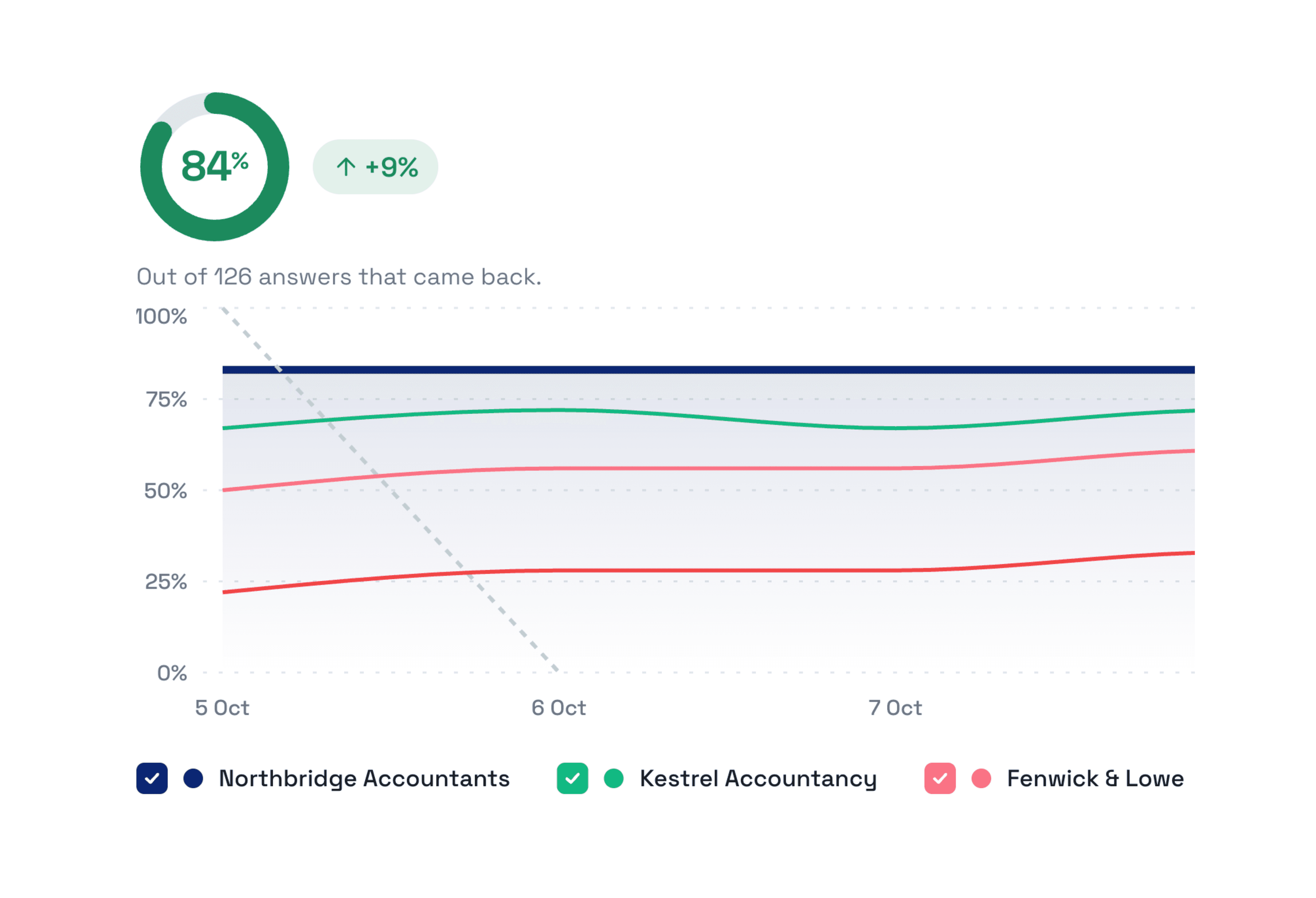
Mention rate. Out of all your checks, how often is your business named in the answer? If you check 20 times and appear in 6 answers, your mention rate is 30%.
Citation rate. How often does the answer list your website as a source? Being named and being linked are different things, so track both.
Who's named instead. Which competitors appear most often when you don't. This shows who you're up against in AI answers.
How you're described. Is the answer accurate and up to date? Check your services, location and prices.
Which sources AI relies on. Are answers drawing on your own website, review sites or directories? That points to where your reputation is being built.
The trend. One reading means little. What matters is whether these numbers rise or fall over weeks.
How to measure your AI visibility by hand

You can do this with a spreadsheet and a free hour. Here's a simple routine.
Write your questions. List 10 to 20 questions a customer might ask. Mix short ones such as "best accountants in Leeds" with longer, specific ones that describe a situation.
Pick your tools. Start with ChatGPT, Perplexity and Google's AI Overviews or AI Mode.
Use a fresh chat each time. That stops earlier conversations from colouring the answer. It's our precaution rather than a rule.
Record what you see. Make a column for the date, the tool, the question, whether you were mentioned, whether you were cited, who was named instead and how you were described.
Repeat each question a few times. One run isn't enough, for the reasons above.
Work out your rates. Divide the number of answers that mention you by the number of checks. Do the same for citations.
Do it again on a schedule. Monthly works for a by-hand routine. Write down any changes you make to your website between rounds.
It works, but the checks add up fast. Fifteen questions across three tools, each run three times, is 135 checks. That's the main reason most people end up using a tool.
What your website analytics can tell you
Two free sources add to the picture. Neither shows the whole story.
Google Analytics. Look for visits that arrive from AI tools, such as chatgpt.com, perplexity.ai, claude.ai, gemini.google.com and copilot.microsoft.com. One guide to tracking AI traffic in GA4 shows how to set up a filter. It says ChatGPT often adds utm_source=chatgpt.com to links, though not to all of them. Treat the total as a minimum. Clicks from apps and copied links often show up as direct visits. Clicks from Google's AI Overviews and AI Mode get counted as ordinary Google search.
Google Search Console. Google's generative AI performance report shows impressions, meaning how many times links to your site were shown in AI Overviews and AI Mode. You can see them by page, country, date and device. Google says it reached all websites on 31 August 2026. It usually only appears once your site has enough AI impressions.
Neither tells you whether you were mentioned without a link, or what the answer actually said. Some of the value also never shows up as a visit, because people may read an answer and look you up later. That last point is our reasoning rather than a measured figure.
What not to trust
A single answer. It might be your best result or your worst. You can't tell which.
A "ranking position" in AI. The order of brands in an answer changes constantly. A mention rate is a better measure than a position.
Tools that don't explain their method. Ask how many times a tool runs each question and how it handles the variation. The SparkToro authors called for tracking providers to publish transparent, reviewable reports.
Small moves. If you check 20 times, a jump from 25% to 30% is a single extra answer. That could easily be chance.
How often to check and what a good result looks like
We can't give you a standard "good" score, because it depends on your industry and how many competitors there are. A better test is to compare yourself with the competitors who get named, then watch your own trend.
Check monthly if you're doing it by hand. A tool can check more often, which makes the trend easier to see. After you change something on your website, give it a few weeks before judging the result. The basics of what to change are in How to Get Your Business Recommended by ChatGPT. The wider picture is in GEO vs SEO: What's the Difference?
Find out how you show up
Doing this by hand is a good way to learn how AI talks about your business. Keeping it up is the hard part.
Midwaver asks ChatGPT, Perplexity and Google AI Overviews the questions your customers ask. It then shows you the answers. You can see how often you're mentioned and how that's trending, which questions bring you up, which competitors are named instead, where your website is cited, which sources AI tools rely on and how you're described. It points to opportunities and exports PDF and CSV reports. So you get the trend without the spreadsheet.
Midwaver can't make an AI tool recommend you and no tool can. It shows you where you stand so you can tell whether what you change makes a difference.
Search is changing. Your customers used to search on Google or Bing and get a list of links. Now they’re asking AI for recommendations. Is your business being recommended? Start your free 7 day trial with Midwaver. See what AI says about your business, who’s winning in your industry and how to get mentioned more. No credit card needed, no obligation.
Don’t let AI search send your customers to a competitor.
See who's being recommended, find where you're missing out and start improving your visibility today.
No credit card required