You Rank on Google. So Why Doesn't ChatGPT Recommend You?
You rank on Google but ChatGPT never names your business. These are the 7 most common reasons.
10 minutes

You're on page one of Google. Then a customer asks ChatGPT "who's the best plumber in Lincoln?" and it names three of your competitors. Not you.
Annoying, right? Here's what's happening. Google hands people a page of links and lets them pick. ChatGPT picks for them. To make its short list it has to be able to read your site, find other websites saying good things about you and be confident you fit the question. Ranking well on Google only gets you part of the way.
Seven things usually get in the way:
Your website is turning AI away
AI can't read your pages properly
You wrote for keywords but people are asking questions
Nobody else is vouching for you
Your business details don't match across the web
A competitor is already the default answer
You've only checked one answer on one platform
It sounds like a lot, but most of these are fixable and a few take about ten minutes. Let's go through them.
Why does ChatGPT ignore a business that ranks on Google?

Because ranking and recommending are two different jobs. On Google you can sit in position three and still get clicks. In an AI answer there is no position three. You're either named or you're not.
It makes up its mind differently too. For a single question, many AI tools run several searches behind the scenes, read a few pages and mix that with what they already know about businesses. A great page of yours helps. It just can't win on its own if nobody else online says you're any good.
The tools don't agree with each other either. One UK test of accountants in six cities found that most of the businesses recommended were named by only one of the three AI tools. So missing from ChatGPT doesn't mean missing everywhere.
Your Google ranking isn't wasted, by the way. Plenty of AI tools search the web before they answer, so ranking well helps them find you. It's one signal among several, that's all.
How do you check whether ChatGPT is recommending your business?
Take the searches you already rank for, turn them into questions and see who the AI names. That's the whole trick.
Pick 10 searches you rank for. Open Google Search Console and find queries where you're in the top 10 and a real customer would actually use.
Turn each one into a question. People talk to AI the way they'd talk to a friend. "Accountant Leeds" becomes "Who's a good accountant for a small business in Leeds?"
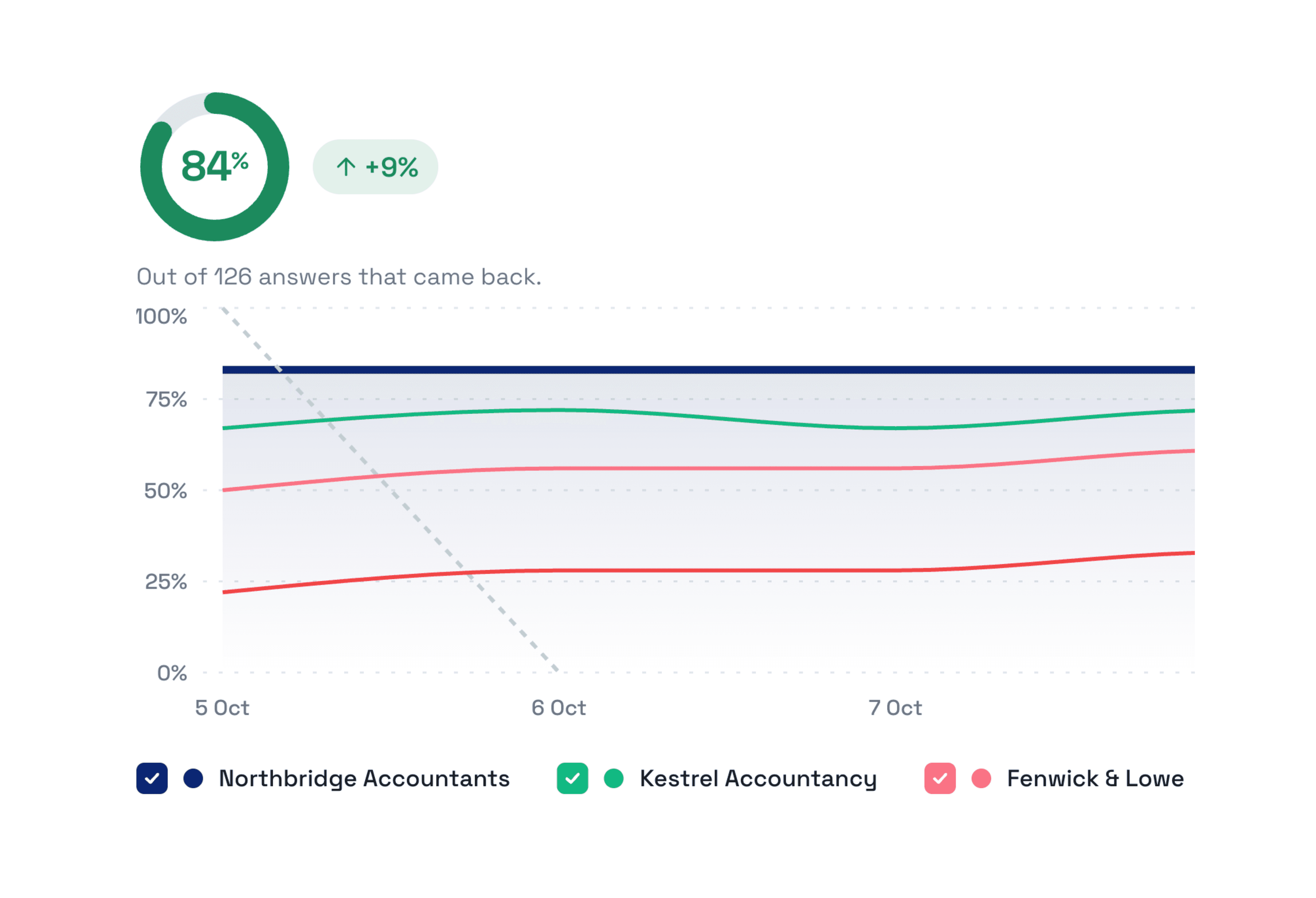
Ask it and write down who gets named. Doing it by hand is fine for a first look. Midwaver asks the same questions every day in ChatGPT, Perplexity and Google AI Overviews. It records whether you were mentioned, whether your site was cited and which other businesses showed up.
Compare the two lists. Rank on Google and show up in AI? Lovely. Rank on Google and never show up in AI? That's your gap, so start there.
Midwaver doesn't track Google rankings, so keep Search Console open next to it. The free trial covers 10 questions, which is plenty for this.
One warning. Don't judge it from a single answer. AI changes its mind from run to run and SparkToro's research found the brand lists were different almost every time. A few days of data tells you far more than one lucky or unlucky check.
Is your website turning AI away?
Quite possibly and often by accident. AI tools can only use pages they can fetch. A robots.txt rule or a firewall setting can let Google straight in while ChatGPT and Perplexity get turned away at the door.
Some businesses do this on purpose to keep their content out of AI training. Fair enough. Just make sure you haven't blocked the search crawlers too, because those are the ones that find and quote your pages. For ChatGPT that's OAI-SearchBot and for Perplexity it's PerplexityBot.
Open yourwebsite.com/robots.txt and look for those names or a rule that blocks everything. Not sure what you're looking at? This walkthrough on how to tell if your website is blocking AI bots covers it, including the hosting side. Or let the Site Health scan in Midwaver test the main AI crawlers for you.
Check Bing while you're at it. ChatGPT's search is reported to use Bing's index among other sources, so a site that's indexed on Google but missing from Bing can slip through. Bing Webmaster Tools is free. Let the search crawlers in, get indexed on Bing and run your check again.
Can AI read your pages properly?
Not always. Google can run a page's scripts before it reads it. Some AI crawlers only read the raw page. So if your services, prices or opening hours only appear after the scripts load, the crawler can end up seeing a nearly empty page. Slow pages and login walls cause the same trouble.
Here's a quick test. Right click your page, choose View Page Source and look for your main text. If it's missing, it's being loaded by script. Site Health also compares what a bot sees with what a browser sees and checks your page speed. The fix is getting your key information into the plain text of the page. Your developer or website platform can usually sort that out.
Did you write for keywords when people are asking questions?
Often, yes. Google matches a search to a page. AI takes a question, breaks it into parts and looks for something that answers each part. You can rank for "boiler repair Leeds" and still have nothing that answers "who can fix a boiler on a Sunday in Leeds?" So the AI quotes someone else.
Go back to the questions in your gap check where you rank but never appear. Read each one out loud and ask if any page on your site answers it directly. The missing answer is usually obvious. Then write it. One plain page per service and location works well, as long as each one is specific.
Do other websites back up what your own site says?

Often not enough. Your website says you're brilliant, but of course it does. AI tools look for other sources that agree, like review sites, directories, trade bodies, news articles and best of lists. A competitor with weaker pages but more mentions around the web can easily win the recommendation.
To see where you stand, look at which websites the AI uses when it answers your questions and whether you're on them. The Sources page in Midwaver lists them and separates your own site and competitor sites from everything else. The third party sites that keep coming up are your target list. You can't get listed on a competitor's own website, so aim for directories, review sites, industry publications and lists.
Do your business details match across the web?
They need to, because AI pieces together who you are from lots of places. If your name, services, location or prices differ between your website, your Google Business Profile and your directory listings, the tool might skip you or get details wrong.
Read the full AI answers for your questions and look for wrong services, old prices or the wrong town. If ChatGPT is already getting things wrong, fixing the sources behind the mistake is the quickest way to correct it. Then pick one correct description of your business and use it everywhere, starting with the oldest listings.
Is a competitor already the default answer?
Sometimes, yes. Some businesses get named again and again even when they rank below you on Google. They're mentioned in lots of places and once a competitor becomes the default, it takes a while to shift them.
The Rankings table in Midwaver lists every business the AI names for your questions, not just the competitors you added. Open one to see the questions where they beat you, look at where they're being mentioned and aim for the same places. Start with the questions where the gap is smallest.
Have you only checked one answer on one platform?
It's a really common mistake. Being ignored by ChatGPT doesn't mean being ignored everywhere. You could show up in Perplexity or Google AI Overviews and still be missing from ChatGPT. And because answers change, one check is just a snapshot.
Midwaver tracks ChatGPT, Perplexity and Google AI Overviews separately every day, so you can see which platform is the problem and whether it's a pattern. Not every Google search shows an AI Overview, so a search without one isn't a miss. Judge your progress over weeks and fix one platform at a time.
What should you fix first?
Start with whatever stops AI reading you at all, then work towards the slower jobs.
Access. Blocked crawlers and unreadable pages are quick to fix and nothing else works until they're sorted.
Business details. This is mostly tidying up what already exists.
Questions and content. Add pages that answer the questions where you're missing.
Mentions on other websites. This is the slowest one but it matters a lot.
The Opportunities page in Midwaver ranks the fixes for your business. Once you know which reasons apply to you, this guide to getting recommended by ChatGPT goes deeper on the fixes.
Why isn't ChatGPT recommending my business?
Usually because it can't read your site, can't find other websites vouching for you or already has a competitor as its go to answer. The checks above show which one it is.
Does ranking on Google help you appear in ChatGPT?
A bit. Lots of AI tools search the web, so a strong ranking helps them find you. But they also weigh what other websites say about you and whether they can read your site, which is why ranking first doesn't guarantee a mention.
How long does it take to start appearing in ChatGPT?
There's no fixed timeline. Unblocking a crawler can help quickly because it can finally read your pages. Building mentions on other websites takes longer. Track your questions weekly so you can see the direction even when the daily numbers wobble.
Should you stop doing SEO?
No. AI tools often search the web to build their answers, so good SEO still helps you get found. Think of AI visibility as an extra layer on top. This piece on how GEO and SEO fit together has the detail.
Are Google AI Overviews the same as ChatGPT?
No. AI Overviews are the AI summaries at the top of some Google results. ChatGPT is a separate tool. They can name different businesses for the same question, so it's worth tracking them separately.
Can you check if ChatGPT recommends your business for free?
Yes. Our free AI visibility report shows whether AI tools mention your business. Our free 7 day trial adds daily tracking of your own questions, so you get a more complete dataset.
Search is changing. Your customers used to search on Google or Bing and get a list of links. Now they're asking AI for recommendations. Is your business being recommended? Start your free 7 day trial with Midwaver. See what AI says about your business, who's winning in your industry and how to get mentioned more. No credit card needed, no obligation.
Don’t let AI search send your customers to a competitor.
See who's being recommended, find where you're missing out and start improving your visibility today.
No credit card required