How to Do Prompt Research for AI Search
Nobody publishes what customers ask ChatGPT, so you have to work it out. Here’s how to find those questions, shape them into a list and check how your business shows up.
5 minutes

If you've ever done keyword research, you'll know the routine. You find the words people type into Google, check roughly how often they're searched and write for the ones that matter. Nothing that tidy exists for AI search.
People don't type two or three keywords into ChatGPT. They ask full questions, add context and follow up. And nobody publishes a list of what they ask or how often.
That doesn't mean you're guessing. It means the job is different. This guide explains how to work out which questions matter to your business, where to find them, how to turn them into a list you can check and what to do with what you learn. It's also the groundwork for getting the most out of Midwaver, an AI visibility tracker that asks those questions for you. If AI search itself is new to you, start with What Is AI Search and Why Should Your Business Care?
What prompt research is
A prompt is whatever someone types or says to an AI tool. "Which commercial cleaning companies in Bristol work evenings for small offices?" is a prompt. Prompt research is working out which prompts matter to your business, meaning the ones your customers ask when they're looking for what you sell.
Think of it as the AI search version of keyword research, with one big difference. A keyword is a short phrase. A prompt is usually a whole sentence and sometimes a paragraph. Google's head of Search, Liz Reid, said in April 2026 that Google has seen meaningfully longer queries since AI Overviews launched. She also said AI Mode tends to attract longer, more complex and more conversational ones. In her words, people are describing what they need rather than boiling it down to keywords.
Why keyword tools can't do this for you
Keyword tools can show search volumes because enough data exists to estimate them. For AI tools it doesn't. As far as we can find, ChatGPT, Perplexity and Google don't publish which prompts people use or how often. Google's Search Console now has a generative AI performance report, but it groups its data by page, country, date and device. It tells you how often links to your site were shown in AI features. It doesn't tell you what people asked.
So when a tool shows you a "prompt volume", treat it as an estimate. The marketing agency Brainlabs, writing about AI visibility data, says prompt volume figures are probabilistic estimates and that the conversion from search volume to AI prompt volume is largely assumed.
That's not a reason to give up. It's a reason to choose your prompts by judgement rather than by a number. You know your customers. You're better placed than any tool to say what they ask.
People ask the same thing in very different ways

Here's the next problem. Two customers with the same need rarely word it the same way. In February 2026 SparkToro published a study in which hundreds of people each wrote a prompt for the same underlying need. They almost never phrased it in similar ways. Yet the AI tools often returned overlapping recommendations. The wording or order changed but the set of businesses was frequently similar. SparkToro's conclusion was that AI models are generally good at recognising the intent behind very different wording.
Treat that with some care. The study was run with Gumshoe, which sells AI tracking tools. It also doesn't spell out every detail of its method. It's a useful indication rather than proof.
The practical lesson is to think in needs rather than exact phrasing. You don't need to find the one perfect wording. You need a handful of realistic ways of asking for each thing you want to be found for.
Where to find the questions your customers ask

Start with what you already have. The best source is almost never a tool.
Your own conversations. Sales calls, enquiry emails, quote requests and support messages are full of real questions in your customers' own words. Look at the first message a new customer ever sent you.
Your customers. Ask new ones how they found you and what they asked or searched for before getting in touch. One extra question on your enquiry form does it.
Google. The "People also ask" boxes, autocomplete suggestions and your Search Console queries show what people ask in a search box. AI prompts are longer, but the topics are a good starting point.
Forums and review sites. Reddit threads, industry forums and reviews show how people describe their problems when nobody is selling to them.
The AI tools themselves. Ask ChatGPT what someone might ask when looking for what you sell. It'll give you ideas, but they're its guesses, not what real people asked.
Write the wording down as you find it. A question in a customer's own words is worth more than a tidied-up version.
The types of question to include

Customers don't all ask the same kind of question, so a good list covers the different ways someone might arrive. Using a commercial cleaning company in Bristol as the example:
Best-of questions. "Who are the best commercial cleaning companies in Bristol?"
Problem-led questions. "How do I get my office cleaned without disrupting staff?"
Specific-need questions. "Which cleaners in Bristol work evenings for a small office?"
Comparison questions. "Should a 10-person office hire a cleaning company or its own cleaner?"
Price questions. "How much does office cleaning cost in Bristol?"
Questions about you. "Is [your business name] any good?"
Don't only track the questions you expect to win. Include your own name too. What an AI tool says when someone asks directly about your business matters because that's often the last check before a customer gets in touch. That's our opinion rather than a documented fact, but it's how most of us behave when we're about to hire someone.
How to turn a list into a prompt set

Once you have a pile of questions, shape them into a set you can check over time. This is the approach we'd take.
Write each one as a full, natural sentence. Word it the way a customer would, including the details that matter, such as where they are, the size of their business and what they need.
Merge duplicates. If three questions mean the same thing, keep the one that sounds most like a real customer.
Group them by what the customer wants. Finding a supplier, comparing options, checking a price or checking you.
Start small. Our suggestion is 10 to 20 questions you'd be upset to miss out on, rather than hundreds. That's a rule of thumb, not a magic number.
Keep them stable. Change the list as little as you can so you can compare results over time. Add new questions rather than rewording old ones.
Resist the urge to put your business name in every question. A customer who doesn't know you yet doesn't ask for you by name.
Test the prompts
Now run them. Put each question into ChatGPT, Perplexity and Google, using both AI Overviews and AI Mode where you can. Then look at what comes back. Is your business named? Who is named instead? Which websites are cited? How are you described?
Do it once to get a feel for things but don't read too much into a single result. SparkToro's earlier research found that the same list of brands almost never came back twice for the same prompt. What counts is the pattern across many questions, checked repeatedly.
That's the point where doing it by hand gets tedious. Midwaver does it for you. It asks your questions across ChatGPT, Perplexity and Google AI Overviews, so you can see how often you're named and how that changes over time.
What to do with what you find

The results are a map of where to work. Look for four things.
Questions where competitors are named and you aren't. These are your biggest gaps. Look at which sites the answers rely on and what those pages say that yours doesn't. Midwaver shows which sources the AI tools rely on, which is a good place to start.
Questions where you're named but your site isn't linked. The AI knows your name but isn't leaning on your website. A page that answers that question properly, from real experience, gives it something to use.
Questions where you do well. Protect them. Keep the page that earns them accurate and up to date.
Wording you hadn't thought of. The terms customers use tell you what to put on your website in plain language. If you want the basics of getting recommended, How to Get Your Business Recommended by ChatGPT covers them.
Come back to the list every few months. Tools change, customers' wording changes and so do your services. Prompt research isn't a one-off job.
Find out how you show up for your questions
Come back to the commercial cleaning company in Bristol. Somewhere right now an office manager is asking an AI tool for help. You've made a list of the questions they'd ask. The next step is to see what the tools say. You can do it by hand or you can let Midwaver do it.
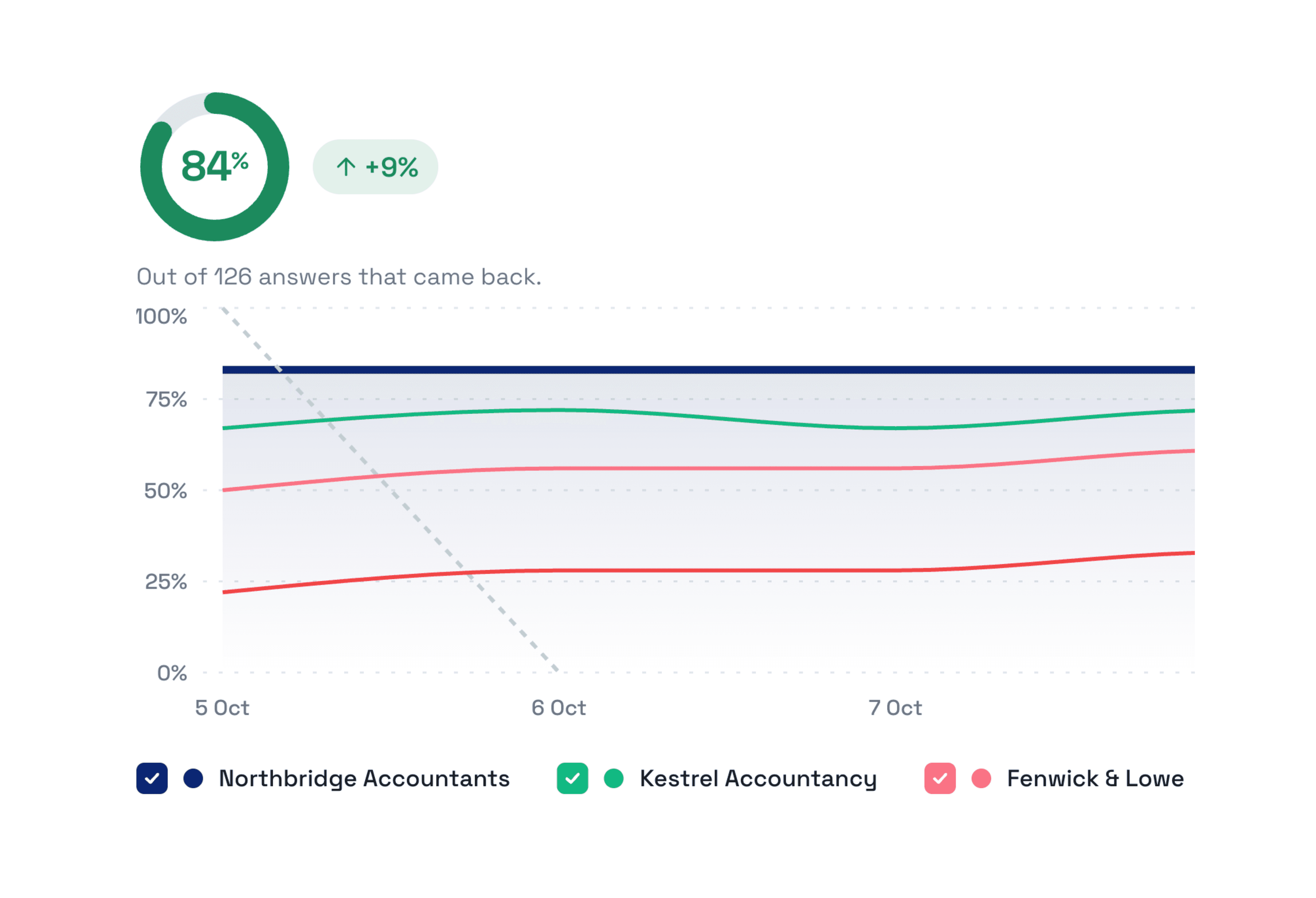
Midwaver is an AI visibility tracker. It asks ChatGPT, Perplexity and Google AI Overviews your questions and shows you the answers. You can see how often you're mentioned and how that's trending, which questions bring you up, which competitors are named instead and where your website is cited. A simple dashboard turns the results into clear next steps.
Midwaver can't make an AI tool recommend you and no tool can. It shows you where you stand so you can see whether what you change makes a difference.
Start your free 7 day trial. There’s no credit card needed and you can track up to 10 questions in your trial per day. If you’d like more detail first, the features and pricing pages cover the rest.
Don’t let AI search send your customers to a competitor.
See who's being recommended, find where you're missing out and start improving your visibility today.
No credit card required